AI Execution Engine vs ChatGPT: What’s the Difference?
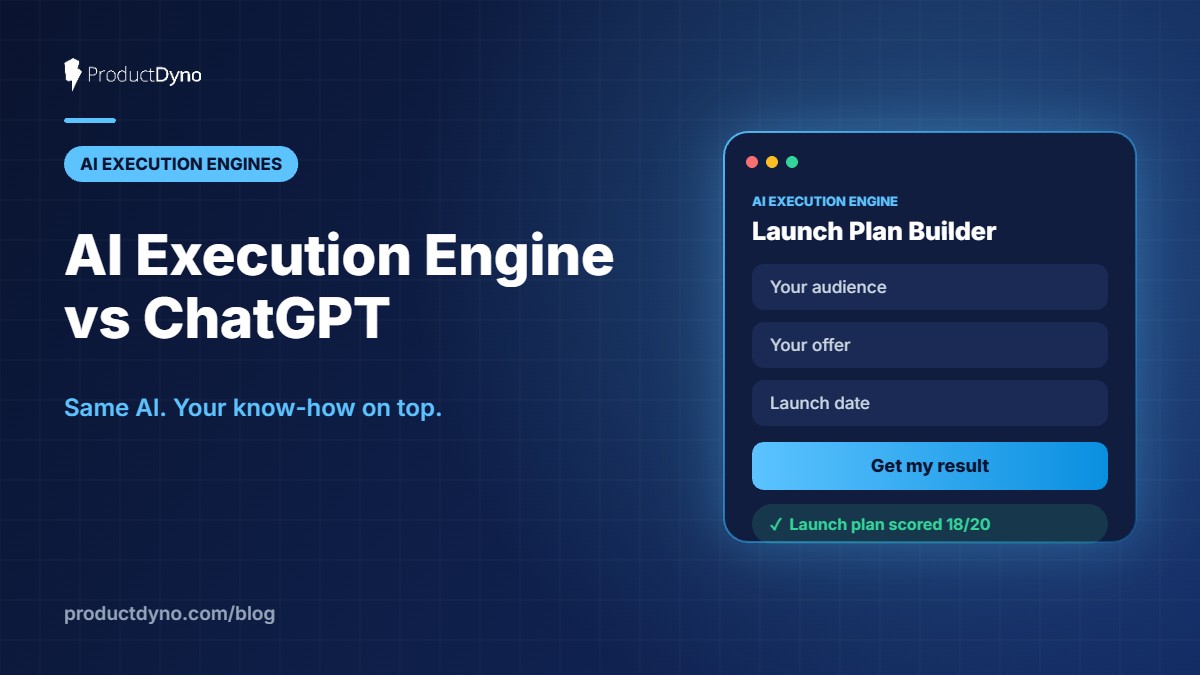
ChatGPT is a general assistant: your customer has to know what to ask and turn the answer into something useful. An AI Execution Engine uses the same AI, but asks your questions, runs your method and delivers a finished result under your brand.
“Can’t my customers just use ChatGPT?” It’s the first question every creator asks about AI tools, and it’s a fair one. Here’s the honest answer, and why it matters for what you sell.
What ChatGPT is great at
ChatGPT, Claude and Gemini are brilliant general-purpose assistants. Ask a good question and you get a good answer. The catch is in that sentence: your customer has to know what to ask, recognise a good answer when they see one, and then turn that answer into something they can use.
That’s a lot of work for someone who came to you precisely because they don’t know how to do the thing.
Where a blank chatbot falls short
- It starts empty. Your customer types “help me plan a launch” and gets generic advice that could apply to anyone.
- It has no method. It doesn’t know the five questions you always ask, the framework you use, or the mistakes you watch for.
- It has no standards. It can’t tell your customer’s plan is weak, because it doesn’t know what “good” looks like in your niche.
- It ends in text. Twelve follow-up prompts later, the customer still has a wall of chat to copy, fix and format.
What an AI Execution Engine does differently
An engine uses the same AI underneath, but wraps it in your expertise:
- It asks your questions in a guided form, so every customer gives it what it needs.
- It runs your method: your steps, your scoring, your rules.
- It delivers a finished result: a plan, a report, a score, an image or a branded PDF.
- It does it under your brand, in your member area or on your site.
Same AI. The difference is the know-how on top, and only you have that.
A side-by-side example
In a blank chatbot: “Help me plan a launch for my dog training course.” The reply is a list of generic launch tips. No idea about the customer’s audience, price or timeline. No plan.
In an engine built by a launch coach: the customer answers five questions about their audience, offer, list size and date. The engine runs the coach’s four-step launch framework, scores the plan against the coach’s criteria, and hands back a dated launch plan as a branded PDF.
Why this matters for your business
You can’t sell ChatGPT. You can sell an engine. It can be a paid product, a reason to join your membership, a lead magnet people actually finish, or a service you build for clients.
And because an engine gets used again and again, it gives customers a reason to stay subscribed, which a course they finish once never does.
See the difference for yourself
The quickest way to feel it is to try one. The free AI Tool Idea Finder asks what you do and what you sell, runs a scoring method on your business and hands you a PDF report with the engine you should build first. Then ask ChatGPT the same question and compare.
Frequently asked questions
Do AI Execution Engines use ChatGPT?
They can use the same kinds of AI models, including models from OpenAI and Anthropic. What’s different is the guided input, your method and the finished output wrapped around the model.
Won’t my customers just copy my method into ChatGPT?
Most won’t, for the same reason most people don’t finish courses: they want the result, not the work. The engine gives them the result in minutes.
Is an engine a chatbot?
Not really. It can include a follow-up chat, but it starts with a structured form and ends with a deliverable. That’s why we call it an execution engine.
Put this into practice with a free AI engine
See your know-how turned into an AI tool your customers can use. Two engines, free, in five minutes.
Keep reading
 AI Execution Engines How to Charge More Every Month for What You Already Sell
Two creators can sell the same know-how and one charges three times more every month. Raise perceived value with AI tools that hand each customer a…
Nov 19, 2026 · 4 min read
 AI Execution Engines Turn What You Already Know Into Monthly Income (Without Building a Course)
You already have the hard part: know-how customers would pay for. In 2027 the fastest product to launch is an AI tool that applies your method…
Nov 19, 2026 · 4 min read
 AI Execution Engines Your First $1,000 a Month: Let Other People Bring You Paying Customers
The first $1,000 a month in recurring income is the hardest. Instead of winning customers one at a time, recruit the people who already have their…
Nov 19, 2026 · 6 min read