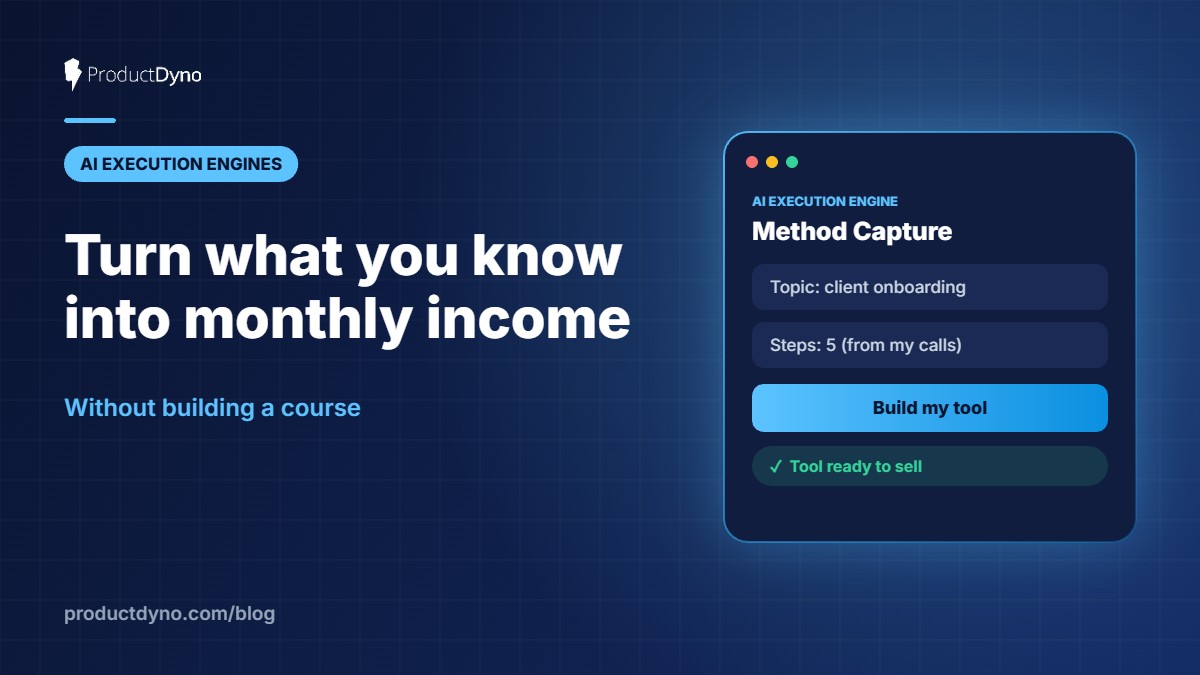
Turn What You Already Know Into Monthly Income (Without Building a Course)
You already have the hard part: know-how customers would pay for. In 2027 the fastest product to launch is an AI tool that applies your method to each customer and hands back a finished result. Build it once and it keeps working, and earning, every month.
You already have the hard part: years of know-how your customers would happily pay for. What used to stand between you and monthly income was months of recording lessons and building a course. Not anymore. In 2027 the fastest product to launch, and the one buyers value most, is an AI tool that applies your method to each customer’s situation and hands back a finished result. Build it once, and it keeps working, and earning, while you get on with your day.
The 2027 rule: AI does the drafting, you supply what AI can’t
Your buyers can already ask ChatGPT or Claude for general advice on your topic, for free. If your product gives them the same, they won’t pay. What they can’t get from an AI chat is:
- Your method: the specific steps, order and rules you use.
- Your stories: what happened when you or your clients tried it.
- Your judgement: what to skip, what usually goes wrong and what “good” looks like.
- Your examples and numbers: real before-and-after results.
Put those into an AI Execution Engine and you have something a free chat can’t copy. See how an engine differs from a ChatGPT prompt.
Step 1: Pick the job your tool will do
Don’t start with “a course on X”. Start with one job your buyers hate doing or get wrong: write the listing description, plan the week’s workouts, score the sales page, draft the client proposal. One job, one finished result. You can add more tools later.
Step 2: Speak your method, don’t type it
People speak at around 150 words a minute and type at around 40. Record yourself walking through how you do the job, as if a client were sitting across from you. Go off-script with stories and warnings: that’s the valuable part. AI transcription is accurate out of the box.
A one-hour build workflow
- Outline (10 minutes). Write the result the tool produces, the 3 to 7 steps, and the questions it needs to ask the customer.
- Talk it through (20 minutes). Record yourself doing the job for a real or imagined client.
- Shape it (15 minutes). Turn the transcript into the engine’s instructions and knowledge, keeping your rules and phrasing.
- Test for voice and truth (15 minutes). Run it on three real cases, cut anything generic, and add the detail only you would know.
Step 3: Reuse what you already have
Most experts are sitting on months of material: old webinars, coaching calls, emails, blog posts, slide decks and support answers. That’s exactly what an engine needs as knowledge. Upload it, and the tool answers in your voice with your examples. You can also turn an existing course or PDF into an AI tool in an afternoon.
Using licensed (PLR) content without it feeling recycled
Private label rights content can speed things up, but never publish it as-is. Use it as raw knowledge, mix it with your own stories and method, and change the format: a report becomes a tool that applies its tips to the customer’s situation.
Step 4: Wrap short lessons around the tool
The tool is the product; lessons support it. Add a short “how to get the best result” video, a few examples of great outputs, and a lesson on what to do with the result. From one recording you can deliver video, a written version, audio and a checklist, so every learning style is covered.
Step 5: Outsource the right way
Hire for what AI does badly: video editing, design, real research and interviews, and editing for voice. Don’t pay people to do raw drafting that AI now does in seconds. Judge freelancers on quality and reputation before price, and start with a small paid test.
Step 6: Sell one tool to several audiences
Once a tool works, you can sell it to more people with small changes.
- Adapt it for an underserved group. A puppy-training planner can become a version for large breeds or first-time owners by adjusting its knowledge and questions.
- Write a different sales pitch. A website-traffic tool can have separate pages for coaches, authors and local businesses. Targeted pitches convert better than one generic page.
- License it to agencies. Agencies want AI tools to offer their clients. A white-labelled version of your tool can become their service, and a recurring income for you.
A simple weekly product rhythm
- Monday: pick one job and record your method.
- Tuesday: build and test the engine.
- Wednesday: record the short “best results” lesson.
- Thursday: cut the recording into an email, social posts and a demo for prospects.
- Friday: read customer results and questions, and improve the tool.
Frequently asked questions
What is the fastest product to create in 2027?
An AI tool that does one job using your method. Record yourself doing the job, turn it into an AI Execution Engine, test it on real cases, and add a short lesson on getting the best results.
Can I use AI to create my product?
Use it to draft, structure and power the tool, not to replace your expertise. The value has to come from your method, stories, judgement and real examples.
Is PLR content still worth using?
Only as raw material. Mix it with your own method and turn it into something new, such as a tool that applies it to each customer’s situation.
Do I still need courses?
Short lessons still help people get the most from a tool, and some buyers love courses. But the tool is what people pay for each month; the lessons support it.
Put this into practice with a free AI engine
See your know-how turned into an AI tool your customers can use. Two engines, free, in five minutes.
Keep reading
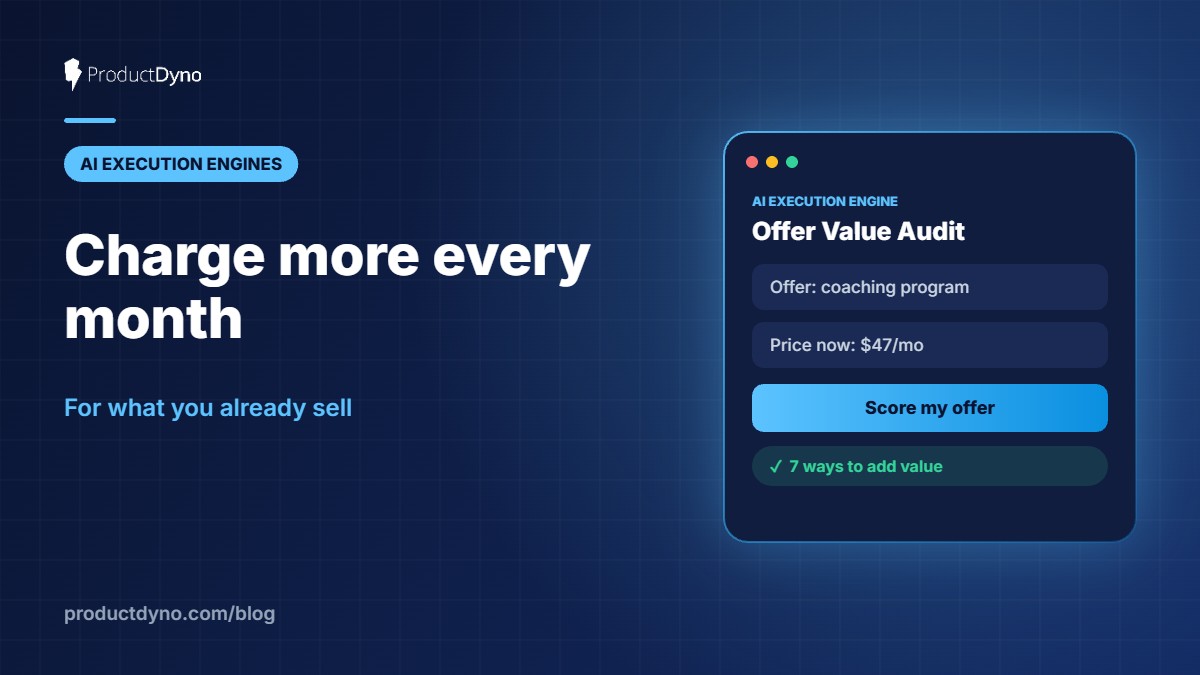 AI Execution Engines How to Charge More Every Month for What You Already Sell
Two creators can sell the same know-how and one charges three times more every month. Raise perceived value with AI tools that hand each customer a…
Nov 19, 2026 · 4 min read
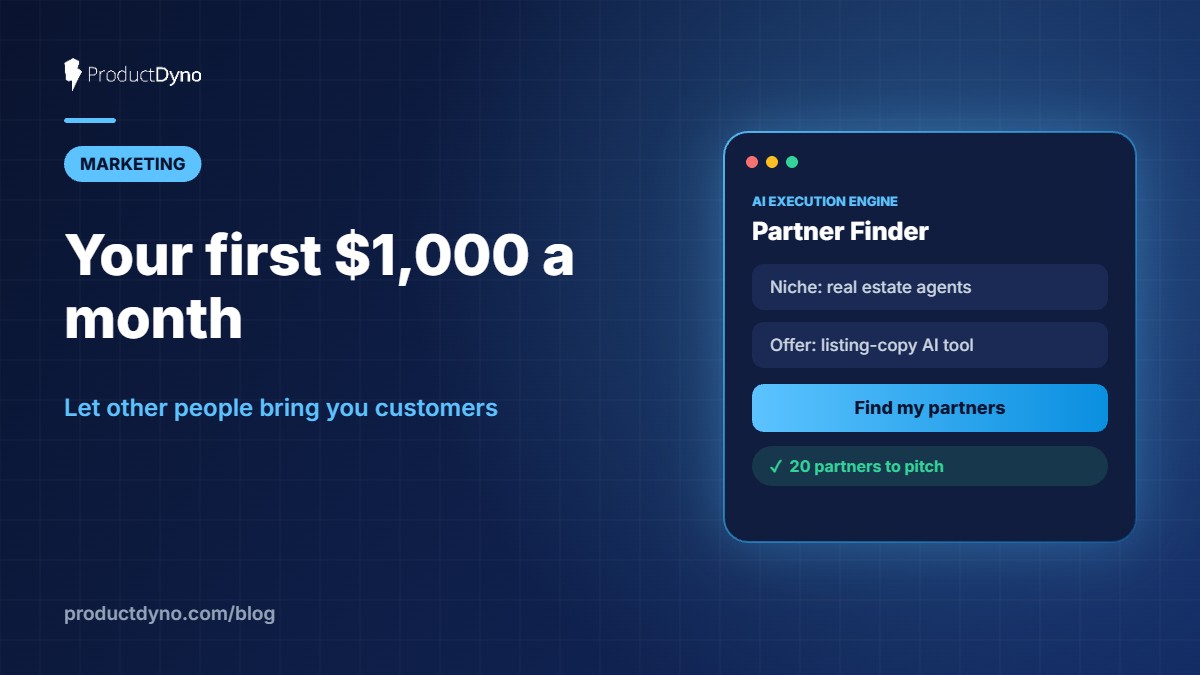 AI Execution Engines Your First $1,000 a Month: Let Other People Bring You Paying Customers
The first $1,000 a month in recurring income is the hardest. Instead of winning customers one at a time, recruit the people who already have their…
Nov 19, 2026 · 6 min read
 AI Execution Engines The Day-One Win That Keeps Customers Paying You Every Month (With Template)
The customers who pay you month after month are the ones who got a result in their first week. Make the first step an AI tool…
Nov 19, 2026 · 3 min read