The Day-One Win That Keeps Customers Paying You Every Month (With Template)
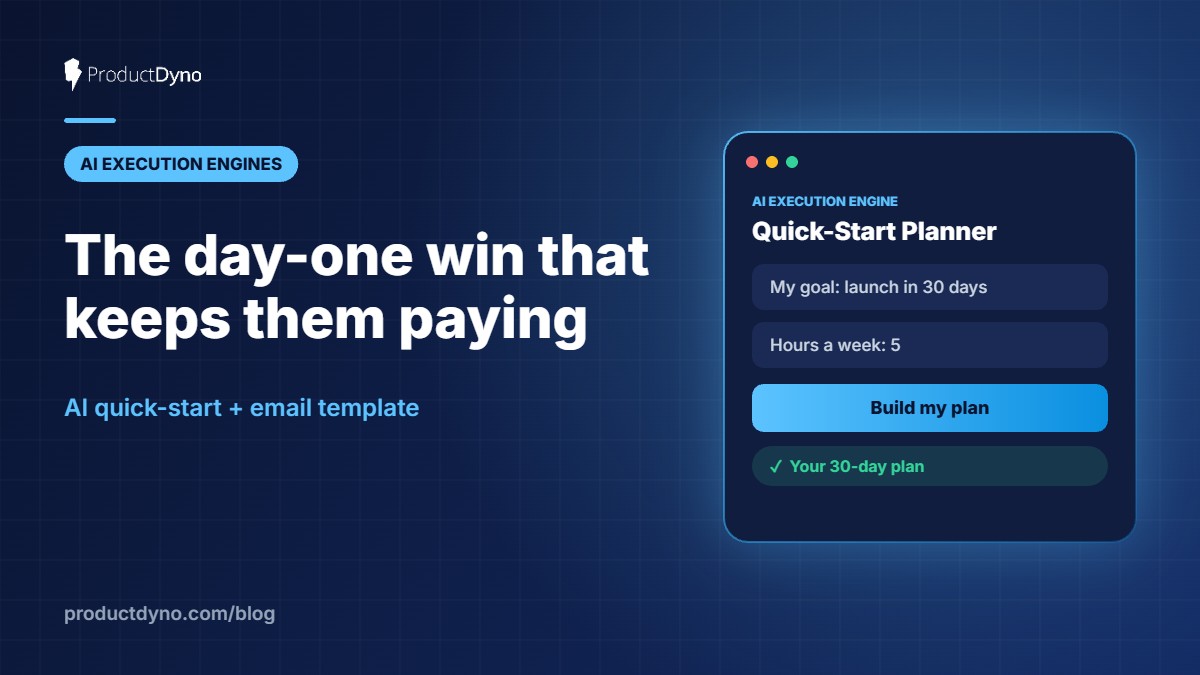
The customers who pay you month after month are the ones who got a result in their first week. Make the first step an AI tool that builds a personal plan from your method, then follow with three to four weeks of short emails: daily at first, then spaced out.
The customers who pay you month after month are the ones who got a result in their first week. The ones who cancel usually never got started. Good onboarding is the cheapest way to protect your recurring income: get every new buyer a real win on day one, then keep them moving. Here is how, with an AI quick-start tool and a ready-to-use email schedule.
The 2027 shift: onboarding that does something
Old onboarding was a welcome email and a “start with module 1” link. Emails can only tell people what to do. An AI Execution Engine helps them do it. Make the very first step an engine: the new buyer answers a few questions and gets a personal starting plan, audit or draft from your method in minutes. That’s a real win on day one, and a reason to come back on day two.
This works whether you sell an AI tool, a coaching program, a course or a client service. Agencies can use the same idea with new clients: a short intake engine that turns their answers into a first deliverable before the kickoff call.
Step 1: Pick the first win
Ask: what’s the smallest useful result a new buyer could get in five minutes? A 30-day plan, a scored audit of their website, three rewritten headlines, a first client email. Build that as your quick-start engine.
Step 2: List your main benefits
Write down the tools and features buyers value most. For a fitness coach that might be the meal planner engine, the workout builder, recipe videos, a weekly check-in engine and a live call. Each main benefit gets its own email, so this list sets the minimum length of your sequence.
Step 3: Add a useful tip to each email
Don’t just say “try the meal planner”. Add something useful, such as a prompt that gets a better result from it, so every email is worth opening.
Step 4: Plan helpful recommendations
Think about what else buyers need to succeed. Where it genuinely helps, recommend an upgrade, a done-for-you service or a related tool. This is often where your extra income comes from, and it should always serve the buyer first.
Step 5: Write the welcome email
- Thank them for buying.
- Give login details and a direct link.
- Send them straight to the quick-start engine: “Answer five questions and get your plan.”
- Remind them of the two or three main benefits, so they feel good about their decision.
Step 6: One benefit per email after that
Each following email highlights one tool or feature, explains why it matters, shares a tip and links straight to it.
Step 7: Get the timing right
Send the first few emails close together while excitement is high, then space them out. Run the sequence for at least three to four weeks.
| When | What it covers | |
|---|---|---|
| 1 | Right after buying | Welcome, login, quick-start engine |
| 2 | Day 1 | “How did your plan look?” plus main benefit #1 |
| 3 | Day 2 | Main benefit #2 |
| 4 | Day 4 | Main benefit #3 |
| 5 | Day 6 | Main benefit #4 |
| 6 | Day 10 | Main benefit #5 |
| 7 | Day 14 | Check-in: run the engine again with your progress |
| 8 | Day 21 | Main benefit #6 |
| 9 | Day 28 | What’s next: an upgrade or done-for-you option |
You can also use AI to draft the whole sequence from your list of benefits, then edit it in your own voice.
How ProductDyno helps
ProductDyno hosts your AI engines, unlocks tools and lessons over time, and connects to your email platform so the sequence sends itself. New buyers get a personal result before they’ve finished their coffee, and you keep 100% of your sales.
Find your first-win engine
The free AI Tool Idea Finder suggests the engine that would give your buyers the fastest first win.
Frequently asked questions
How long should an onboarding sequence be?
At least three to four weeks, with one email per main benefit. Daily at first, then every few days, then weekly.
What should the first email include?
A thank-you, login details, and one quick first step, ideally an AI tool that gives them a personal result in minutes.
Should onboarding emails sell anything?
Mostly no. Focus on helping buyers use what they paid for. Recommend extras only where they genuinely help.
Does this work for agency clients too?
Yes. An intake engine that turns a new client’s answers into a first deliverable makes the first week feel productive and sets up the relationship well.
Put this into practice with a free AI engine
See your know-how turned into an AI tool your customers can use. Two engines, free, in five minutes.
Keep reading
 AI Execution Engines How to Charge More Every Month for What You Already Sell
Two creators can sell the same know-how and one charges three times more every month. Raise perceived value with AI tools that hand each customer a…
Nov 19, 2026 · 4 min read
 AI Execution Engines Turn What You Already Know Into Monthly Income (Without Building a Course)
You already have the hard part: know-how customers would pay for. In 2027 the fastest product to launch is an AI tool that applies your method…
Nov 19, 2026 · 4 min read
 AI Execution Engines Your First $1,000 a Month: Let Other People Bring You Paying Customers
The first $1,000 a month in recurring income is the hardest. Instead of winning customers one at a time, recruit the people who already have their…
Nov 19, 2026 · 6 min read