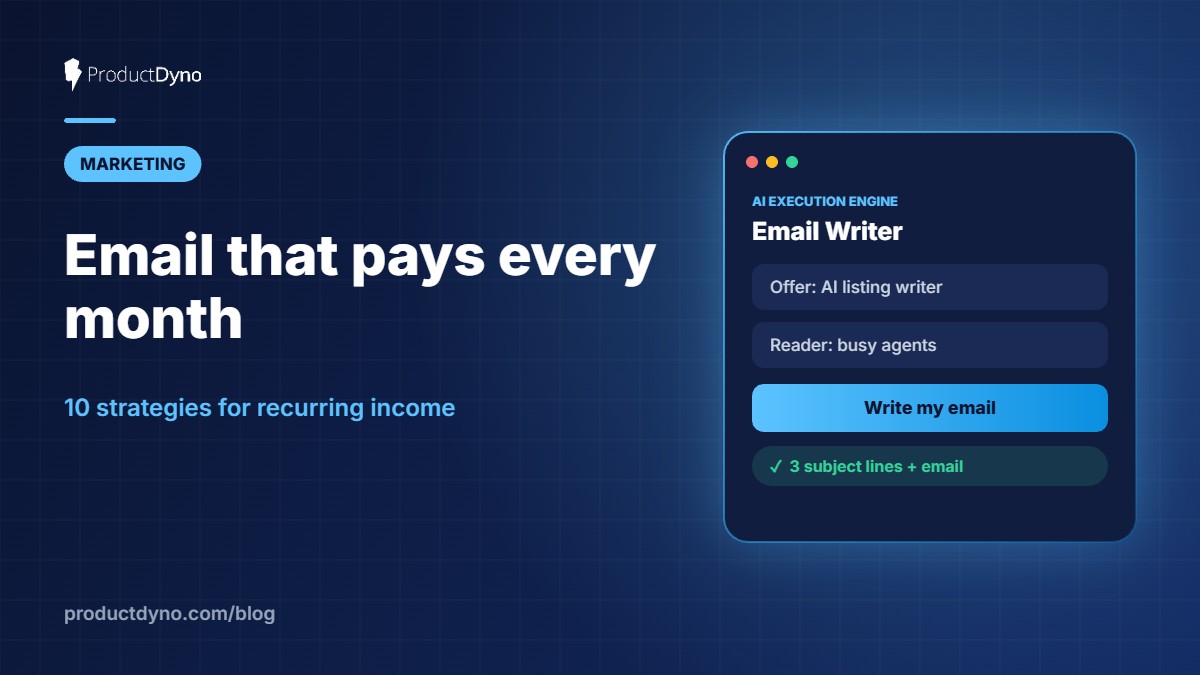
Email That Pays Every Month: 10 Strategies for Recurring Income in 2027
Your email list is the channel you own, and it is where recurring income is won and kept. Segment by plan and behaviour, personalise with what customers did, test short subject lines, send a free AI tool instead of a link, use one call to action, and email consistently.
Social platforms change their rules every year. Your email list is the one channel you own, and it’s still where most recurring income is won and kept: it brings in new paying customers and reminds existing ones why they keep paying. These are the ten email strategies we’ve used across our own products for years, updated for 2027.
1. Segment by plan, interest and behaviour
An email that’s perfect for an advanced user goes over a beginner’s head, and an email about a dog-training tool means nothing to someone who bought your golf planner. Split your list by:
- Plan or level: free, starter, pro, agency.
- Product or interest: what they bought or signed up for.
- Behaviour: active, quiet for 14 days, used the tool this week, close to renewal, cancelled.
When we split our own customers into beginner and advanced groups, clicks on the targeted content went up. In ProductDyno, plans and products give you these segments automatically, and you can pass them to your email platform.
2. Personalise with what they did, not just their name
Use the first name in the email every time, and in the subject line now and then. Name-in-subject tests raised our open rates by about 15%, but used every time it stops working. Subject lines that worked well for us:
- [Product name] Here’s what’s new, John
- John, your plan is ready
- Heads up, John
In 2027 you can go much further: reference the result their AI tool produced last week, the goal they told it, or the tool they haven’t tried yet. That relevance, not the name, is what really lifts clicks.
3. Design for phones first
Most people read email on their phones. Send a test to yourself and check it on a phone, a tablet and a computer. Short paragraphs, one column and a big tappable button beat a fancy layout.
4. Test subject lines constantly
Send two versions and keep the winner. One test that consistently works for us: a question against a statement. Questions create curiosity. Often all it takes is a question mark.
Because we run several email platforms (Kit, GetResponse, AWeber and our own server), we send the same email on each with a different subject line, compare open rates, and put the winners into our automated sequences.
- Short: about 3 to 6 words, like a newspaper headline.
- A hook word that starts a conversation: “Mind blown,” “I regretted this,” “Heads up.”
- Honest: the email has to deliver what the subject line promised.
5. Send a tool, not just a link
An email that says “read my new article” gets a click. An email that says “paste your sales page here and get a score in 60 seconds” gets used, forwarded and remembered. A small free AI tool is the strongest lead magnet and nurture email there is, because people get a personal result on the spot. Add share buttons and a referral reward and subscribers bring their friends. See our first 100 users playbook.
6. Read your numbers, then fix the weak step
- Low opens: fix the subject line, the sender name or your sending reputation.
- Opens but few clicks: the email is too long, or the call to action is unclear.
- Clicks but few sales: the problem is the page you sent people to, not the email.
When we analysed our own emails, very targeted subject lines with short, punchy content raised click-through rates by 40%.
7. Give subscribers something they can’t get anywhere else
Exclusive value is a strong reason to buy and to renew. An AI tool built on your method is exclusive by nature: nobody else has your method inside it.
The partner trick we used for a $497 offer
Creating all that exclusive value yourself is a lot of work. So we asked our joint-venture partners and friends: would you put something you normally charge for inside our product, free for our customers, in exchange for the leads? A couple of dozen said yes. They contributed recordings of paid live events, video courses and even subscriptions to their software. Our customers got far more value, our partners got new paying customers on their lists, and we got an easier sale. Everybody won. In 2027, partners can contribute AI tools the same way.
8. One email, one clear call to action
Tell people exactly what to do: “Run the planner,” “Join the webinar,” “Try the free tool.” Vague links get vague results. Match the call to action to the subject line and add a real deadline when there is one.
9. Look the same every time
Use the same colours, header, logo placement and sign-off in every email and inside your product. Our emails have had the same header for years: cartoon versions of our co-founders Jeremy and Simon, our signature green and the Promote Labs logo. People tell us they recognise our emails instantly, and that shows up as higher opens and clicks.
10. Email consistently, and more often than you think
Pick a rhythm and stick to it. We email every day, and it has increased our sales. People who don’t want your emails will unsubscribe whether you send daily or monthly. We’ve seen friends with lists of 50,000 or 100,000 people send nothing for six months. When they finally mailed, they made sales, and they also lost people who had forgotten who they were. Too few emails is a bigger risk than too many.
Using AI to write your emails
AI can draft a full welcome or sales sequence in minutes. Tell it who the reader is and what stops them buying, what your tool does in specific terms, your real stories and numbers, and paste a few of your best past emails for voice. Then edit every draft. A step up from a prompt is an AI tool that knows your offer and writes on-brand emails for you or your affiliates every time: that’s what AI Execution Engines are for. Agencies can sell exactly this to clients as a monthly service.
Five emails every AI tool or program should have running
- Welcome: a first result within minutes of buying. Our day-one onboarding playbook has the full sequence.
- “What’s new”: new tools and features, named and linked.
- “We miss you”: sent after 14 days without using the tool, with one easy thing to run.
- Before renewal: a reminder of the results they’ve had, sent before the charge.
- Win-back: a reason to return for people who cancelled, sent 30 to 60 days later.
Frequently asked questions
How often should I email customers?
Consistency matters more than the exact number, but more often is usually better. Weekly is a good minimum, and many successful creators, including us, send daily.
What is a good subject line length?
About 3 to 6 words. Short subject lines read fully on phones, avoid spam triggers and work like a headline.
What’s the best lead magnet for an AI tool?
A small free version of the tool that gives a personal result in a minute or two. People experience your method instead of reading about it.
Can AI write my emails?
Yes, as a first draft. Give it your audience, offer, real stories and best past emails, then edit for accuracy and voice.
Put this into practice with a free AI engine
See your know-how turned into an AI tool your customers can use. Two engines, free, in five minutes.
Keep reading
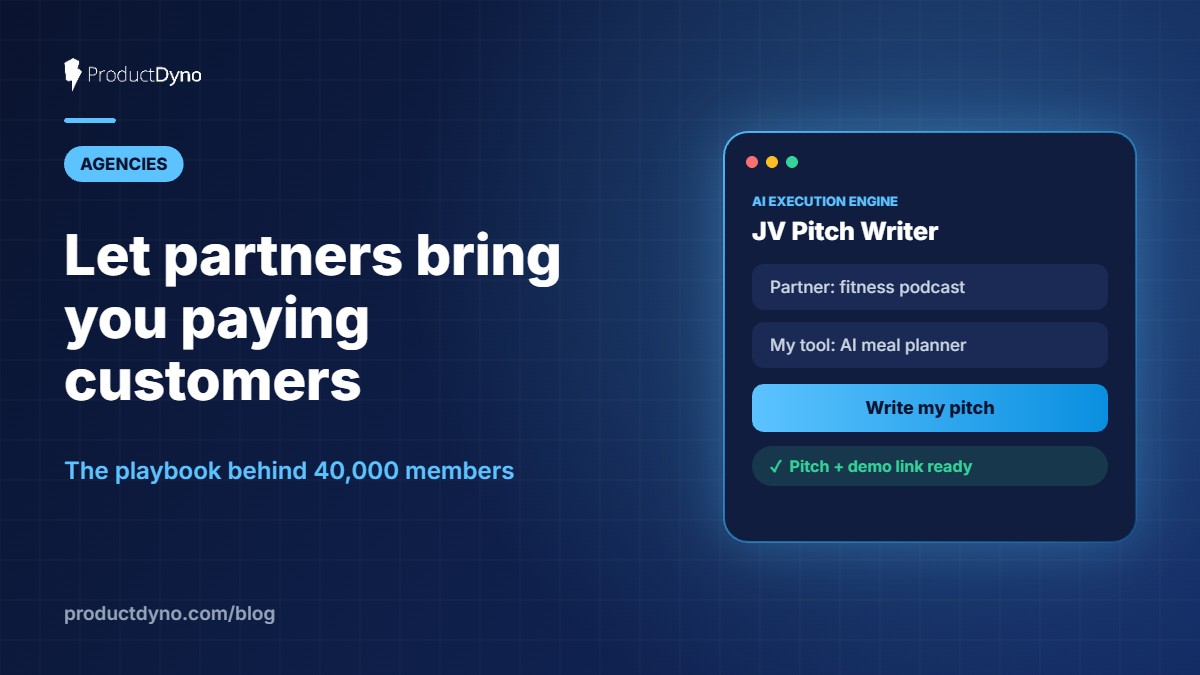 Agencies Let Partners Fill Your Business With Paying Customers (The Playbook Behind 40,000 Members)
Partnerships are still the fastest, cheapest way to get customers paying you every month. Help first, choose partners with the same audience and a different offer,…
Nov 19, 2026 · 4 min read
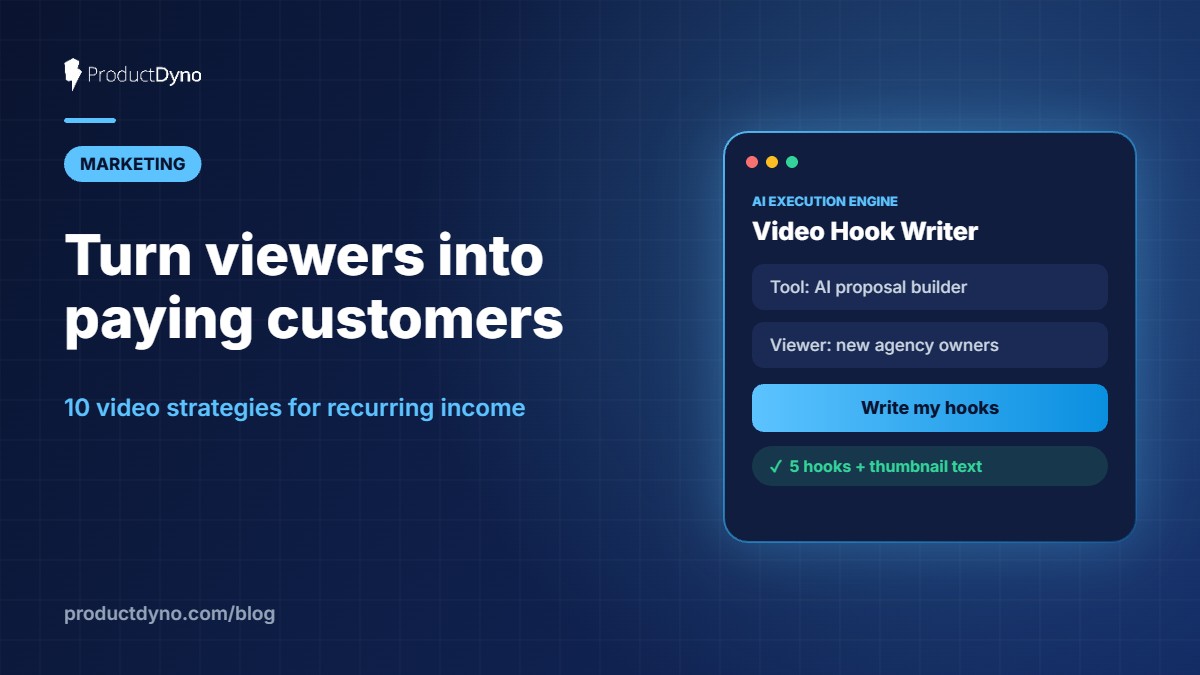 Marketing & Growth Turn Viewers Into Paying Customers: 10 Video Strategies for Recurring Income
Video is the fastest way for a stranger to trust you enough to pay you every month. Open with a story, show your AI tool doing…
Nov 19, 2026 · 4 min read
 Marketing & Growth Turn Followers Into Monthly Income: A 10-Step Social Media System for 2027
Followers do not pay the bills; customers paying you every month do. Give every post a job, work backwards from a sign-up goal, film your AI…
Nov 19, 2026 · 4 min read